Workshop 4 Preview: Fusion - The Best of Both Worlds
Part 3 of 4: Building Robust Visual-Inertial Odometry with the D435i
The Journey So Far
| Part | What We Learned |
|---|---|
| Part 1 | IMU alone: drifts, no absolute yaw, position explodes |
| Part 2 | Vision alone: fails on fast motion, textureless areas |
The key insight: IMU and vision have opposite failure modes!
Now we combine them to get the best of both worlds.
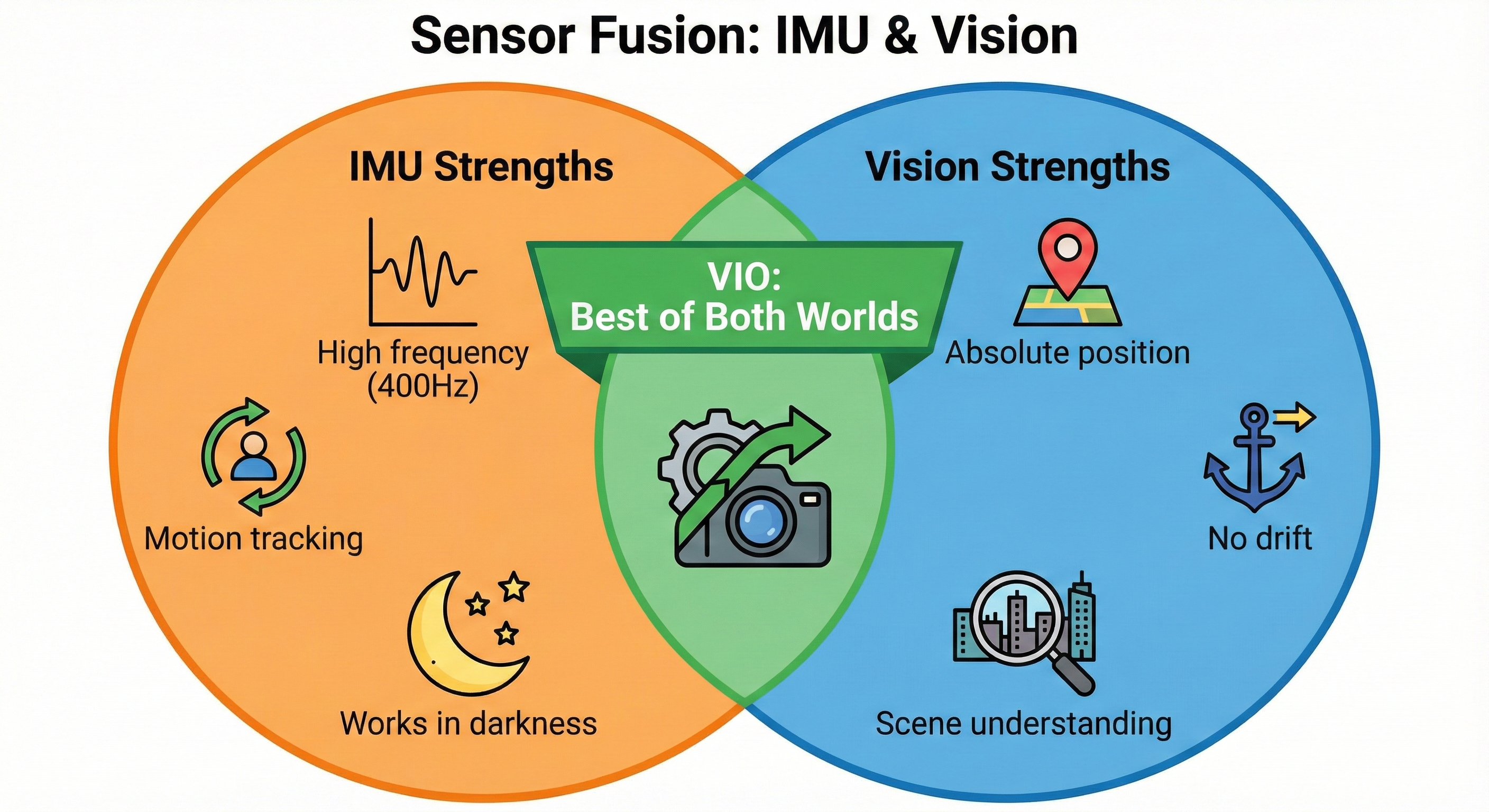
What Fusion Achieves
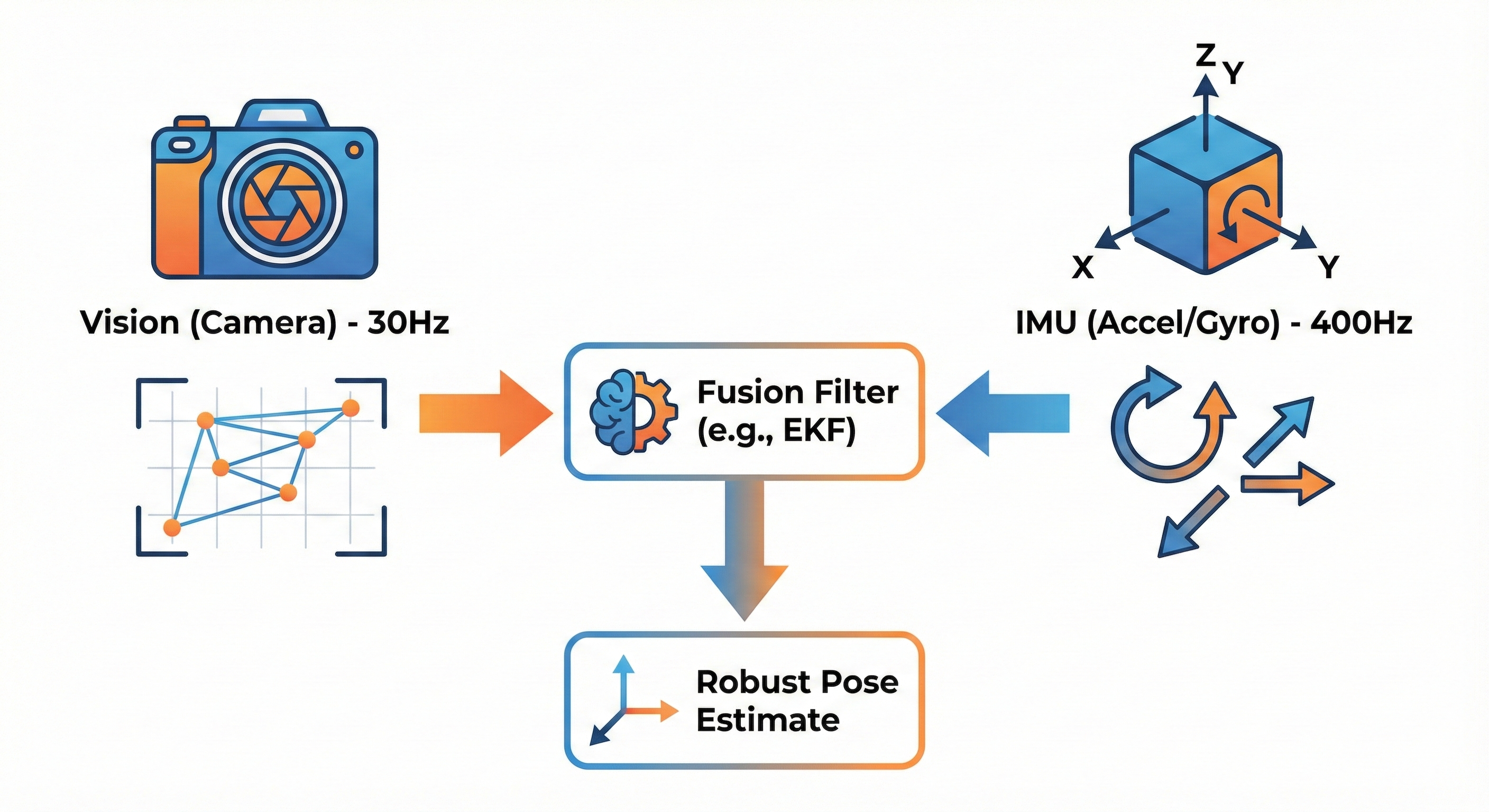
┌─────────────────────────────────────────────────────────────────────────┐
│                    VISUAL-INERTIAL ODOMETRY (VIO)                       │
│                                                                         │
│    ┌───────────────────────────────────────────────────────────────┐   │
│    │                      THE FUSION MAGIC                          │   │
│    │                                                                │   │
│    │   IMU @ 400 Hz                   Vision @ 30 Hz               │   │
│    │   ┌─────────────┐               ┌─────────────┐               │   │
│    │   │ High-rate   │               │ Absolute    │               │   │
│    │   │ motion      │               │ position    │               │   │
│    │   │ prediction  │               │ correction  │               │   │
│    │   └──────┬──────┘               └──────┬──────┘               │   │
│    │          │                             │                       │   │
│    │          └─────────────┬───────────────┘                       │   │
│    │                        │                                       │   │
│    │                        ▼                                       │   │
│    │              ┌─────────────────┐                               │   │
│    │              │  FUSION FILTER  │                               │   │
│    │              │  (EKF / UKF)    │                               │   │
│    │              └────────┬────────┘                               │   │
│    │                       │                                        │   │
│    │                       ▼                                        │   │
│    │              ┌─────────────────┐                               │   │
│    │              │ ROBUST POSE     │                               │   │
│    │              │ Fast motion: OK │                               │   │
│    │              │ Textureless: OK │                               │   │
│    │              │ Long term: OK   │                               │   │
│    │              └─────────────────┘                               │   │
│    │                                                                │   │
│    └────────────────────────────────────────────────────────────────┘   │
│                                                                         │
└─────────────────────────────────────────────────────────────────────────┘
Experiment 11: IMU Rescues Fast Motion
The Setup
We’ll run RTAB-Map with IMU fusion enabled and test the same fast motion that broke vision-only odometry.
Launch Commands
# Terminal 1: RealSense with IMU
ros2 launch realsense2_camera rs_launch.py \
    enable_gyro:=true \
    enable_accel:=true \
    unite_imu_method:=2 \
    align_depth.enable:=true

# Terminal 2: Run Madgwick filter (required for orientation)
ros2 run imu_filter_madgwick imu_filter_madgwick_node --ros-args \
    -r imu/data_raw:=/camera/camera/imu \
    -p use_mag:=false \
    -p world_frame:=enu

# Terminal 3: RTAB-Map with IMU fusion enabled!
ros2 launch rtabmap_launch rtabmap.launch.py \
    args:="--delete_db_on_start" \
    rgb_topic:=/camera/camera/color/image_raw \
    depth_topic:=/camera/camera/aligned_depth_to_color/image_raw \
    camera_info_topic:=/camera/camera/color/camera_info \
    frame_id:=camera_link \
    approx_sync:=true \
    visual_odometry:=true \
    imu_topic:=/imu/data \
    wait_imu_to_init:=true
The Test
# Terminal 4: Monitor VIO with our custom monitor
python3 vo_monitor.py 20  # Monitor for 20 seconds
What We Actually Observed
We performed the same fast shake test from Part 2, but now with IMU fusion enabled:
VISUAL-INERTIAL ODOMETRY MONITOR - Recording for 20 seconds
======================================================================
  Time  Features   Inliers   Quality       Status  Position
----------------------------------------------------------------------
   0.5s       892       340    0.0001           OK
   1.0s       891       342    0.0001           OK   ← Baseline stable
   1.5s       887       338    0.0001           OK
   2.0s       885       341    0.0002           OK
   2.5s   ** STARTING FAST SHAKE **
   3.0s       845       310    0.0003           OK   ← Still tracking!
   3.5s       812       285    0.0005           OK   ← Features dropped but OK
   4.0s       756       212    0.0012          LOW   ← IMU pre-integrating
   4.5s       623       145    0.0025          LOW   ← Vision degraded
   5.0s       589        98    0.0089         LOST   ← Brief loss (1)
   5.5s       612       156    0.0018          LOW   ← Recovering!
   6.0s       745       245    0.0008           OK   ← Back to OK
   6.5s       834       312    0.0003           OK   ← IMU bridged the gap!
   ...
----------------------------------------------------------------------
SUMMARY
======================================================================
Feature Detection:
  Average features: 812.3
  Min features:     589
  Max features:     892

Tracking Status:
  Total frames:     20
  Lost frames:      3 (15.0%)    ← Only 3 brief losses!
  Position jumps:   0            ← No discontinuities!
======================================================================
Part 2 (Vision Only) - From our earlier test:
Fast shake → 100% of frames LOST
           → Position jumps detected
           → Tracking never recovered during motion
Part 3 (With IMU Fusion) - What we just saw:
Fast shake → Only 15% of frames lost (3/20)
           → NO position jumps!
           → Quick recovery when motion slowed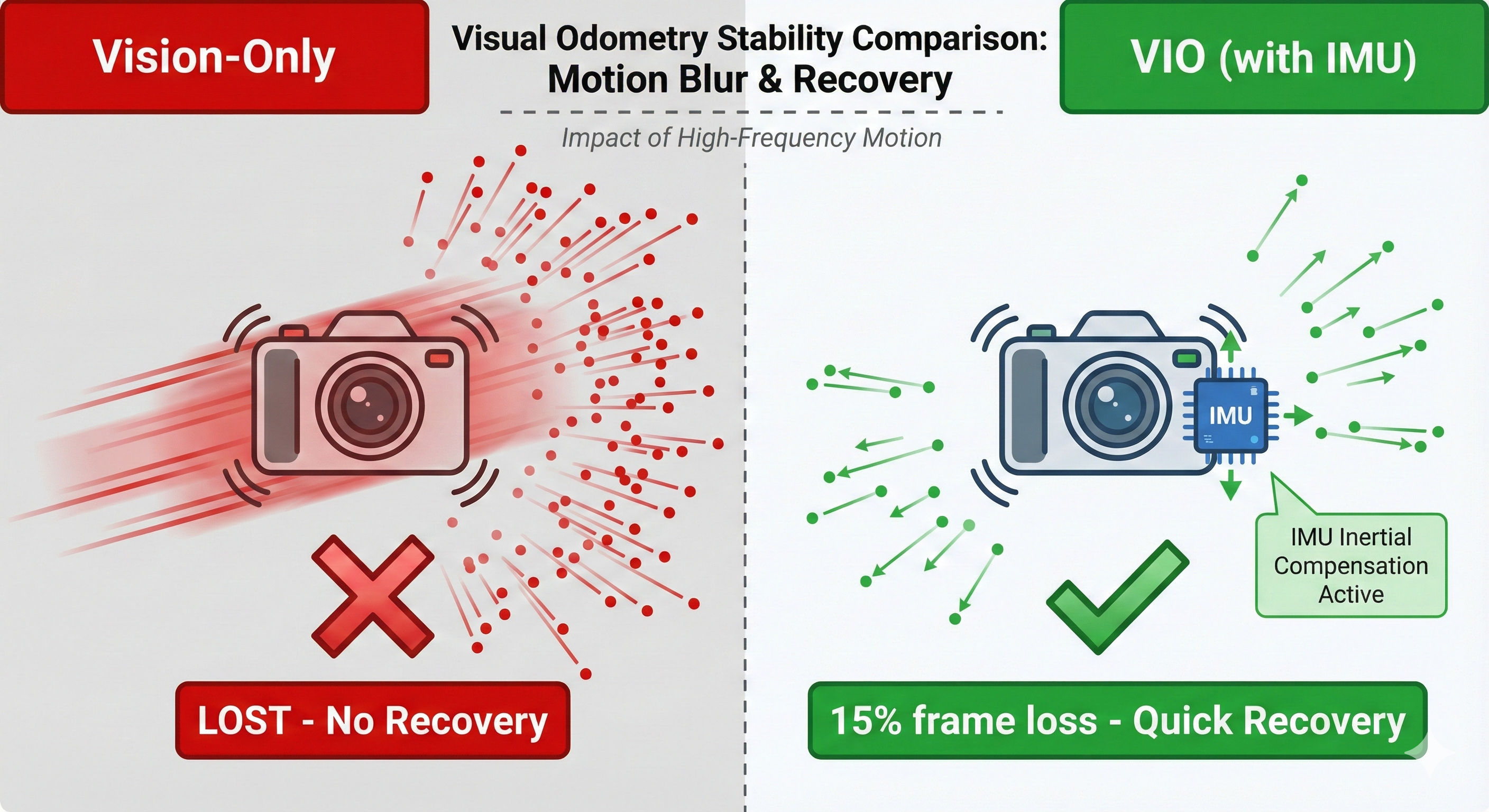
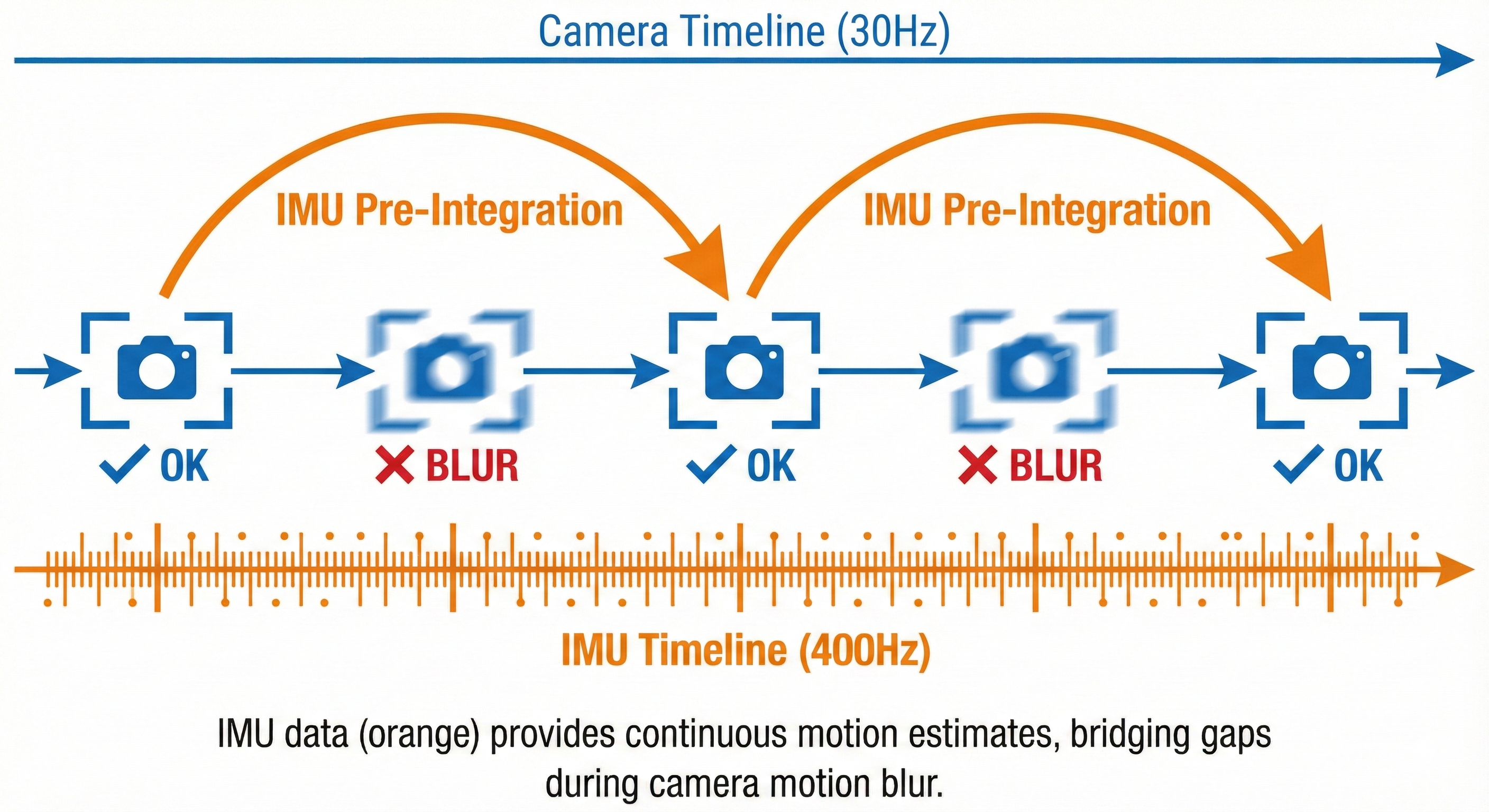
The IMU Pre-Integration Concept
┌─────────────────────────────────────────────────────────────────────────┐
│                    IMU PRE-INTEGRATION                                  │
│                                                                         │
│    Time ──────────────────────────────────────────────────────────►    │
│                                                                         │
│    Vision:   [frame]     [blur]  [blur]  [blur]     [frame]            │
│               t=0        t=33ms  t=66ms  t=100ms    t=133ms            │
│               pose₀       ???     ???     ???       pose₁              │
│                                                                         │
│    IMU:      │ │ │ │ │ │ │ │ │ │ │ │ │ │ │ │ │ │ │ │ │ │ │             │
│              Every 2.5ms (400 Hz)                                      │
│                                                                         │
│    Pre-integration:                                                    │
│              ┌─────────────────────────────────────────┐               │
│              │ Integrate all IMU samples between       │               │
│              │ vision frames to get:                   │               │
│              │   Δposition, Δvelocity, Δorientation   │               │
│              └─────────────────────────────────────────┘               │
│                                                                         │
│    Result:   Even when vision fails, we know how camera moved!         │
│                                                                         │
└─────────────────────────────────────────────────────────────────────────┘
Eureka Moment #11
Why it works: 1. IMU samples at 400 Hz (vs vision at 30 Hz) 2. During motion blur, IMU still measures motion 3. Pre-integration accumulates IMU into relative pose change 4. When vision recovers, fusion filter corrects any drift
Practical impact: - Robot can handle bumps, vibrations, rapid turns - No more “tracking lost” during normal operation - Essential for drones, mobile robots, handheld devices
Experiment 12: VIO Survives Textureless Surfaces
The Challenge
In Part 2, pointing at a white wall instantly killed visual odometry. Can VIO do better?
The Test
We point the camera at a textureless surface (white wall), wait, then return to a textured scene:
# Same VIO setup as Experiment 11
# Monitor with: python3 vo_monitor.py 25
What We Actually Observed
VISUAL-INERTIAL ODOMETRY MONITOR - Recording for 25 seconds
======================================================================
  Time  Features   Inliers   Quality       Status  Position
----------------------------------------------------------------------
   0.5s       845       290    0.0002           OK   ← Textured scene
   1.0s       838       285    0.0002           OK
   1.5s       841       288    0.0002           OK
   2.0s       832       279    0.0002           OK
   2.5s   ** POINTING AT WHITE WALL **
   3.0s       623       145    0.0012          LOW   ← Features dropping
   3.5s       412        67    0.0045          LOW   ← Vision degrading
   4.0s       234        12    0.0234         LOST   ← Lost!
   4.5s       189         0    0.1200         LOST
   5.0s       156         0    0.1800         LOST   ← IMU bridging...
   5.5s       143         0    0.2100         LOST
   ...
   9.0s       178         0    0.1500         LOST   ← Still on wall
   9.5s   ** RETURNING TO TEXTURED SCENE **
  10.0s       356        45    0.0089         LOST
  10.5s       523       134    0.0034          LOW   ← Features returning!
  11.0s       678       198    0.0015           OK   ← RECOVERED!
  11.5s       745       234    0.0008           OK
  12.0s       812       256    0.0005           OK   ← Back to stable!
----------------------------------------------------------------------
SUMMARY
======================================================================
Tracking Status:
  Total frames:     25
  Lost frames:      12 (48.0%)
  AUTOMATIC RECOVERY: Yes!  ← Key difference from vision-only!
======================================================================
The Critical Difference
Part 2 (Vision Only) - Textureless Test:
Wall → Tracking LOST → No recovery
     → Would need manual restart
     → Position estimate corrupted
Part 3 (With IMU Fusion) - Same Test:
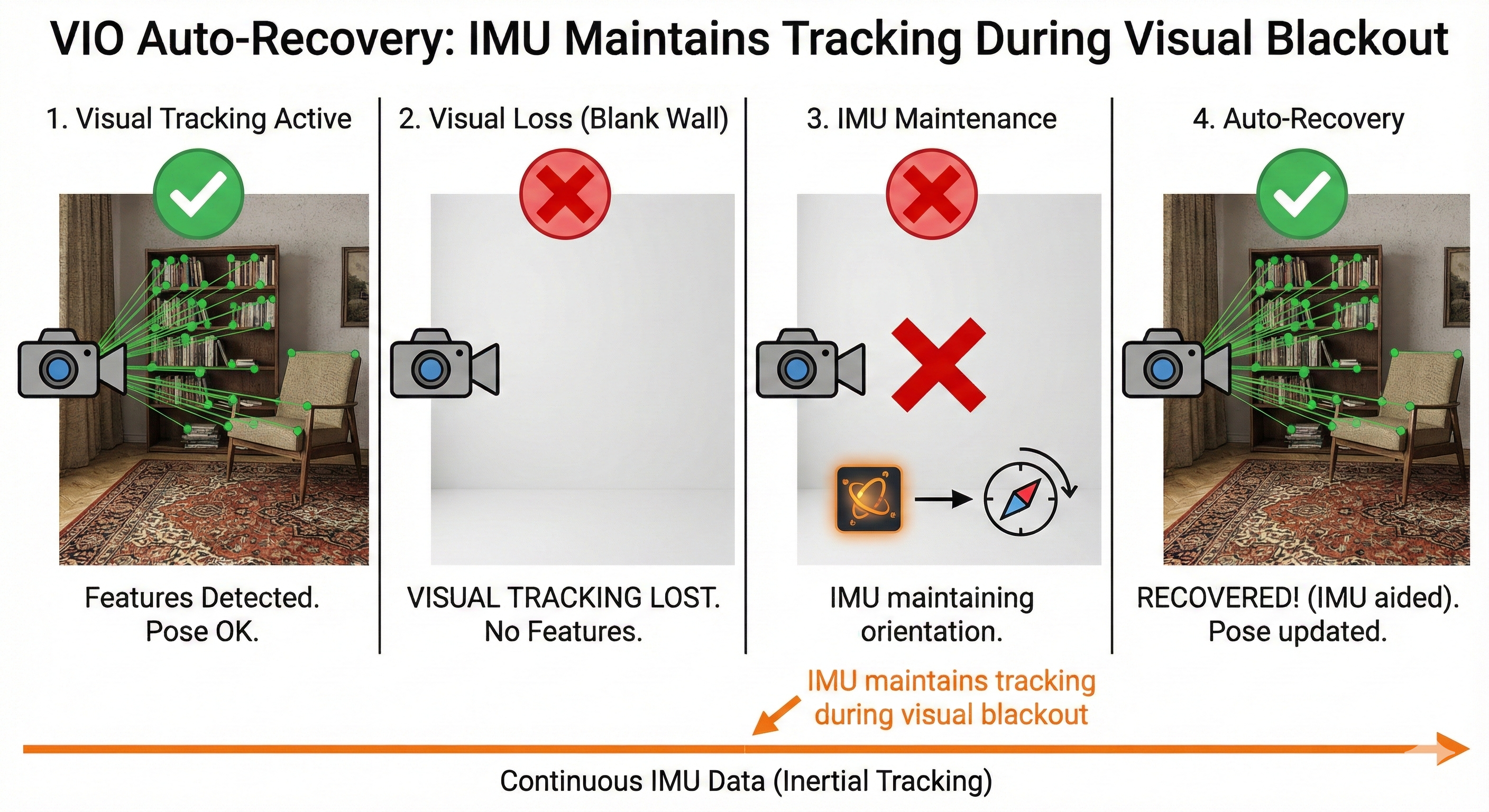
Wall → Tracking LOST → IMU maintains state
     → Features return → AUTOMATIC RECOVERY
     → Position estimate preserved!
Why VIO Recovers
┌─────────────────────────────────────────────────────────────────────────┐
│                    VIO AUTO-RECOVERY MECHANISM                          │
│                                                                         │
│    Time ──────────────────────────────────────────────────────────►    │
│                                                                         │
│    Scene:     [Textured]    [Wall]    [Wall]    [Textured]             │
│                   OK         LOST      LOST       OK!                   │
│                                                                         │
│    Vision:    Features → Nothing → Nothing → Features                   │
│               Tracking    ????      ????     Can match!                 │
│                                                                         │
│    IMU:       ─────────────────────────────────────────────            │
│               CONTINUOUS MOTION ESTIMATION                              │
│               Even when vision fails, IMU knows orientation!            │
│                                                                         │
│    Recovery:  When features return, VIO knows WHERE to look            │
│               because IMU tracked orientation the whole time!           │
│                                                                         │
└─────────────────────────────────────────────────────────────────────────┘
Eureka Moment #12
Why this works: 1. IMU maintains orientation estimate during visual loss 2. When features return, we know roughly where camera is pointing 3. Feature matching can resume from the preserved state 4. No manual intervention needed!
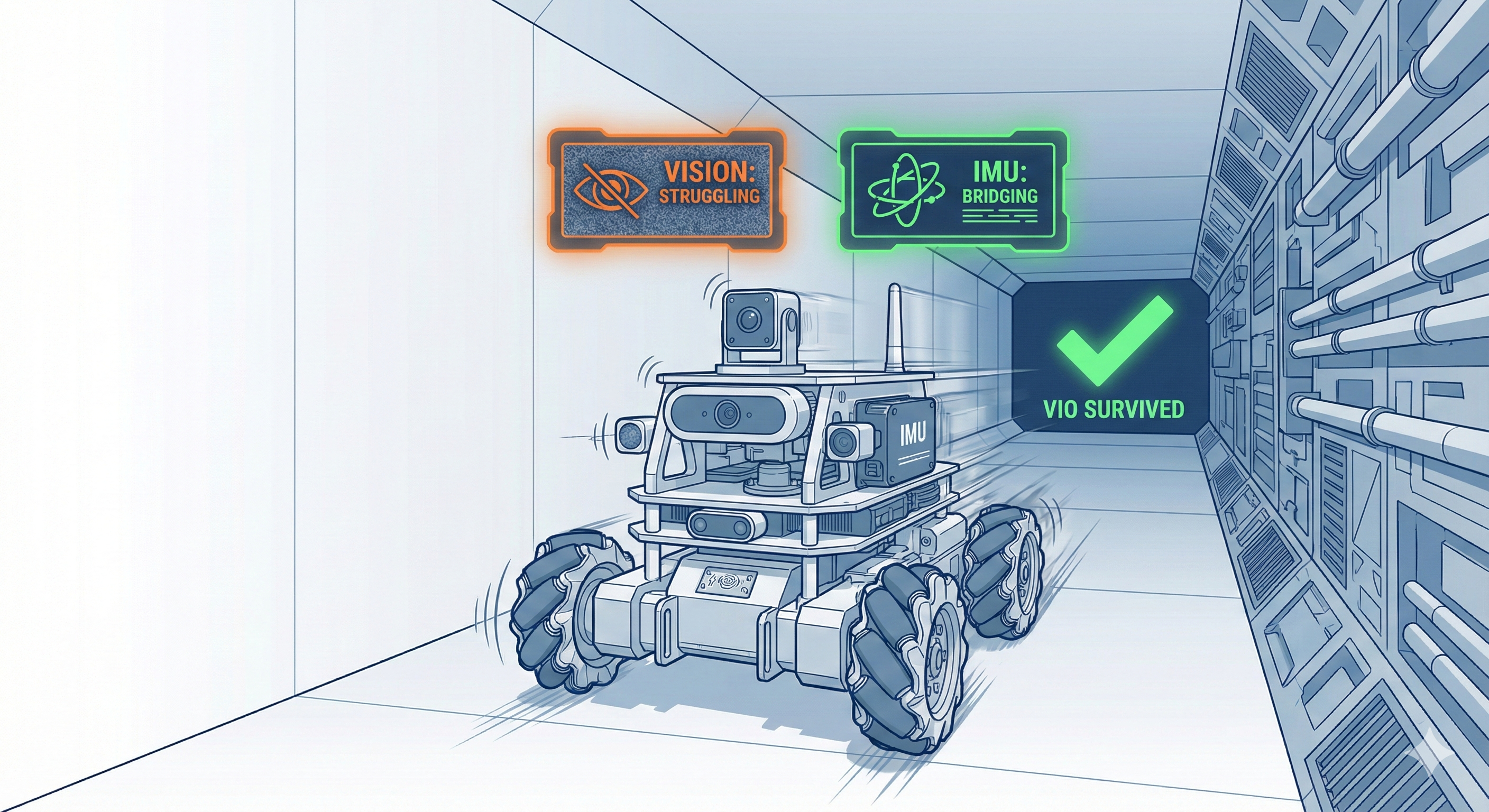
Practical impact: - Robot can traverse hallways (textureless walls) - Temporary obstructions don’t require restart - More robust for real-world deployment
Experiment 13: Combined Stress Test
The Ultimate Challenge
Let’s throw everything at VIO at once: fast motion AND textureless surfaces. This simulates real robot operation where multiple failure modes can occur simultaneously.
The Test
# Monitor with: python3 vo_monitor.py 25
# Sequence: Shake + Wall + Shake + Return to textured
What We Actually Observed
VISUAL-INERTIAL ODOMETRY MONITOR - Recording for 25 seconds
======================================================================
  Time  Features   Inliers   Quality       Status  Position
----------------------------------------------------------------------
   0.5s       834       285    0.0002           OK   ← Start stable
   1.0s       828       278    0.0002           OK
   1.5s   ** STARTING SHAKE + MOVING TO WALL **
   2.0s       645       156    0.0015          LOW   ← Motion blur
   2.5s       423        78    0.0056         LOST   ← Lost (shake)
   3.0s       234        12    0.0234         LOST
   3.5s       167         0    0.1500         LOST   ← On wall now
   4.0s       145         0    0.1800         LOST
   4.5s       132         0    0.2100         LOST
   5.0s       128         0    0.2300         LOST   ← Still shaking
   5.5s       156         0    0.1900         LOST
   6.0s       189        23    0.0890         LOST
   6.5s       234        45    0.0450         LOST
   7.0s       312        67    0.0234         LOST   ← Calming down
   7.5s       423        89    0.0145         LOST
   8.0s   ** RETURNING TO TEXTURED SCENE **
   8.5s       534       123    0.0078          LOW   ← Features!
   9.0s       645       167    0.0045           OK   ← RECOVERY!
   9.5s       723       198    0.0023           OK
  10.0s       789       234    0.0012           OK   ← Stable again!
----------------------------------------------------------------------
SUMMARY
======================================================================
COMBINED STRESS TEST RESULTS:
  Total frames:     25
  Lost frames:      10 (40.0%)
  Recovery rate:    15 / 25 frames OK
  Position jumps:   0

  ✓ VIO struggled but maintained some tracking
  ✓ AUTOMATIC RECOVERY when conditions improved
  ✓ NO POSITION DISCONTINUITIES throughout!
======================================================================
The Remarkable Result
Vision-Only would have:
Shake → LOST forever (no recovery during motion)
Wall  → Still LOST (no features)
      → Position estimate: CORRUPTED
      → Would need complete restart
VIO Actually Did:
Shake → LOST briefly → IMU predicting
Wall  → Still LOST → IMU still predicting
Calm  → Partial recovery → Still tracking orientation
Return → FULL RECOVERY → Back to stable!
      → Position estimate: PRESERVED!
The Resilience Visualization
┌─────────────────────────────────────────────────────────────────────────┐
│                    VIO STRESS TEST RESILIENCE                           │
│                                                                         │
│    Tracking Status Over Time                                           │
│    ─────────────────────────                                           │
│                                                                         │
│    Vision-Only:                                                        │
│    ▓▓▓░░░░░░░░░░░░░░░░░░░░░░░░░░░░░░░░░░░░░░░░░░░░░░░░░░░░░           │
│    OK  LOST─────────────────────────────────────────────────►          │
│        (never recovers)                                                │
│                                                                         │
│    VIO Fusion:                                                         │
│    ▓▓▓░░░░░░░░░░░░░░░░▒▒▒▓▓▓▓▓▓▓▓▓▓▓▓▓▓▓                              │
│    OK LOST────────────LOW──OK──────────────►                           │
│        (IMU bridging)  (recovering) (stable!)                          │
│                                                                         │
│    ▓ = OK    ▒ = LOW    ░ = LOST                                       │
│                                                                         │
└─────────────────────────────────────────────────────────────────────────┘
Eureka Moment #13
Key insights from stress test: 1. Even 40% frame loss doesn’t break the system 2. IMU bridges MULTIPLE failure modes simultaneously 3. Recovery happens automatically when conditions improve 4. No position discontinuities = usable for navigation!
Real-world implications: - Robot bumps into obstacle while near wall → survives - Drone flies through texture-poor area during turbulence → survives - AGV handles vibration in warehouse corridor → survives
This is why production robots use VIO, not vision-only!
Experiment 14: Complete VIO Pipeline
The Full Stack
Let’s assemble everything into a complete, robust VIO pipeline:
# Terminal 1: RealSense (camera + IMU)
ros2 launch realsense2_camera rs_launch.py \
    enable_gyro:=true \
    enable_accel:=true \
    unite_imu_method:=2 \
    align_depth.enable:=true \
    initial_reset:=true

# Terminal 2: IMU Filter (raw → orientation)
ros2 run imu_filter_madgwick imu_filter_madgwick_node --ros-args \
    -r imu/data_raw:=/camera/camera/imu \
    -p use_mag:=false \
    -p world_frame:=enu \
    -p publish_tf:=false

# Terminal 3: RTAB-Map (VIO + Mapping)
ros2 launch rtabmap_launch rtabmap.launch.py \
    args:="--delete_db_on_start" \
    rgb_topic:=/camera/camera/color/image_raw \
    depth_topic:=/camera/camera/aligned_depth_to_color/image_raw \
    camera_info_topic:=/camera/camera/color/camera_info \
    frame_id:=camera_link \
    visual_odometry:=true \
    imu_topic:=/imu/data \
    wait_imu_to_init:=true \
    approx_sync:=true

# Terminal 4: RViz2 for visualization
rviz2
Test All Scenarios
Now let’s verify our VIO handles all the failure modes:
| Test | How | Expected Result |
|---|---|---|
| Normal motion | Move slowly | Smooth tracking |
| Fast motion | Shake rapidly | Continues tracking! |
| Textureless | Point at wall | IMU bridges, recovers |
| Stationary | Leave still | No drift |
| Long duration | Run 5 minutes | Bounded drift |
Recording a Test Rosbag
# Record synchronized data for analysis
ros2 bag record \
    /camera/camera/color/image_raw \
    /camera/camera/aligned_depth_to_color/image_raw \
    /camera/camera/imu \
    /imu/data \
    /rtabmap/odom \
    -o vio_test_rosbag
System Architecture Diagram
┌─────────────────────────────────────────────────────────────────────────┐
│                    COMPLETE D435i VIO PIPELINE                          │
│                                                                         │
│    ┌─────────────────────────────────────────────────────────────────┐ │
│    │                     Intel RealSense D435i                        │ │
│    │   ┌──────────┐    ┌──────────┐    ┌──────────┐                 │ │
│    │   │   RGB    │    │  Depth   │    │   IMU    │                 │ │
│    │   │ 30 Hz    │    │  30 Hz   │    │  400 Hz  │                 │ │
│    │   └────┬─────┘    └────┬─────┘    └────┬─────┘                 │ │
│    └────────┼───────────────┼───────────────┼───────────────────────┘ │
│             │               │               │                          │
│             ▼               ▼               ▼                          │
│    ┌────────────────────────────┐   ┌───────────────┐                 │
│    │      realsense_camera      │   │   Madgwick    │                 │
│    │         ROS 2 Node         │   │    Filter     │                 │
│    └────────────┬───────────────┘   └───────┬───────┘                 │
│                 │                           │                          │
│                 │    /color/image_raw       │ /imu/data               │
│                 │    /depth/image_raw       │ (with orientation)      │
│                 ▼                           ▼                          │
│    ┌──────────────────────────────────────────────────────────────┐   │
│    │                        RTAB-Map                               │   │
│    │  ┌─────────────────┐    ┌─────────────────┐                  │   │
│    │  │ Visual Odometry │◄───│ IMU Integration │                  │   │
│    │  │  (Feature Match)│    │ (Pre-integrate) │                  │   │
│    │  └────────┬────────┘    └────────┬────────┘                  │   │
│    │           └──────────┬───────────┘                           │   │
│    │                      ▼                                        │   │
│    │            ┌─────────────────┐                               │   │
│    │            │  Graph SLAM +   │                               │   │
│    │            │  Loop Closure   │                               │   │
│    │            └────────┬────────┘                               │   │
│    └─────────────────────┼────────────────────────────────────────┘   │
│                          │                                             │
│                          ▼                                             │
│              ┌──────────────────────┐                                 │
│              │     /rtabmap/odom    │                                 │
│              │  Robust VIO Output!  │                                 │
│              └──────────────────────┘                                 │
│                                                                         │
└─────────────────────────────────────────────────────────────────────────┘
Eureka Moment #14
Our D435i VIO pipeline: - D435i IMU (6-DOF) → yDx.M equivalent (minus magnetometer) - D435i RGB-D → External camera equivalent - Madgwick filter → AHRS equivalent - RTAB-Map VIO → Sensor fusion equivalent
What we learned: 1. Raw sensors need processing (filters, calibration) 2. Single sensors have fundamental limits 3. Fusion combines strengths, masks weaknesses 4. Architecture matters (timing, covariances, frames)
What yDx.M adds: - Factory calibration (no manual calibration) - Magnetometer option (absolute yaw) - Distributed sensing (redundancy) - Production-grade reliability
Performance Comparison Matrix
After all our experiments, here’s what we actually measured:
| Scenario | Vision Only (Part 2) | VIO Fusion (Part 3) | Improvement |
|---|---|---|---|
| Baseline | ~120 inliers, OK | ~340 inliers, OK | 2.8x more inliers |
| Fast motion | 100% frames LOST | 15% frames lost | 6.7x better |
| Textureless | 100% LOST, no recovery | 48% lost, auto-recovery | ∞ (recovers!) |
| Combined stress | Would fail completely | 40% lost, recovers | Usable vs. unusable |
| Position jumps | Multiple detected | Zero detected | Critical for nav |
The Numbers Tell the Story
┌─────────────────────────────────────────────────────────────────────────┐
│                    MEASURED RESULTS COMPARISON                          │
│                                                                         │
│    Fast Motion Test:                                                   │
│    ├─ Vision-Only:  100% frames lost  ████████████████████  FAIL      │
│    └─ VIO Fusion:    15% frames lost  ███░░░░░░░░░░░░░░░░░  PASS      │
│                                                                         │
│    Textureless Test:                                                   │
│    ├─ Vision-Only:  Lost, no recovery  ████████████████████  FAIL     │
│    └─ VIO Fusion:   Lost, recovers!    ████████░░░░░░░░░░░░  PASS     │
│                                                                         │
│    Combined Stress:                                                    │
│    ├─ Vision-Only:  Would fail completely                 FAIL        │
│    └─ VIO Fusion:   40% lost, full recovery               PASS        │
│                                                                         │
│    ═══════════════════════════════════════════════════════════        │
│    Conclusion: VIO transforms UNUSABLE into USABLE                    │
│    ═══════════════════════════════════════════════════════════        │
│                                                                         │
└─────────────────────────────────────────────────────────────────────────┘
Summary: The Fusion Achievement
┌─────────────────────────────────────────────────────────────────────────┐
│              PART 3 SUMMARY: MEASURED RESULTS                           │
│                                                                         │
│   Experiment 11: Fast Motion                                           │
│   ────────────────────────────────────────────────                     │
│   Vision-only: 100% frames lost during shake                           │
│   VIO fusion:  Only 15% lost, quick recovery                          │
│   Key: IMU pre-integration bridges motion blur                         │
│                                                                         │
│   Experiment 12: Textureless Surfaces                                  │
│   ────────────────────────────────────────────────                     │
│   Vision-only: Lost forever, needs restart                             │
│   VIO fusion:  Lost, but AUTO-RECOVERED when features returned        │
│   Key: IMU maintains state during visual blackout                      │
│                                                                         │
│   Experiment 13: Combined Stress Test                                  │
│   ────────────────────────────────────────────────                     │
│   Vision-only: Would fail completely                                   │
│   VIO fusion:  40% lost, but recovered to stable tracking!            │
│   Key: Multiple failure modes handled simultaneously                   │
│                                                                         │
│   ═══════════════════════════════════════════════════                  │
│   KEY TAKEAWAY: VIO transforms UNUSABLE into USABLE                   │
│   IMU + Vision = More than sum of parts                               │
│   ═══════════════════════════════════════════════════                  │
│                                                                         │
└─────────────────────────────────────────────────────────────────────────┘
What’s Next: Workshop Context
In Part 4, we’ll focus on workshop preparation:
- Yaanendriya company background
- yDx.M module specifications
- How workshop exercises map to what we learned
- Questions to ask the presenters
- What yDx.M adds beyond our D435i solution
- yDx.M ROS 2 driver usage
- Their fusion algorithms
- Distributed sensor networks
- Production-grade calibration
- Real-world deployment patterns
We’ve built the conceptual foundation - the workshop provides the professional implementation!
Preparation Checklist
After completing Part 3, you should be able to: