Training Go2-W: Hybrid Wheel-Leg Locomotion Policy
ROSCon India 2025 Workshop Prep - Part 3 of 4
The Challenge: Hybrid Locomotion
Training the Go2-W is fundamentally different from training standard quadrupeds. The policy must learn to:
- Roll on wheels when efficient (flat terrain, high speed)
- Walk on legs when necessary (obstacles, rough terrain)
- Coordinate both seamlessly during transitions
┌─────────────────────────────────────────────────────────────┐
│              GO2-W HYBRID LOCOMOTION MODES                   │
│                                                             │
│  MODE 1: WHEEL ONLY          MODE 2: LEG ONLY              │
│  ────────────────────        ───────────────               │
│  ○═══○    ○═══○              /\    /\                      │
│    ↓        ↓               /  \  /  \                     │
│  Fast, efficient          Obstacles, stairs               │
│  Flat terrain             Rough terrain                   │
│                                                             │
│  MODE 3: HYBRID (The Goal!)                                 │
│  ──────────────────────────                                │
│  Wheels roll + legs stabilize                              │
│  Automatic mode selection based on terrain                 │
│                                                             │
└─────────────────────────────────────────────────────────────┘- Part 1: Isaac Sim vs Isaac Lab
- Part 2: Go2-W ROS 2 Interface
- Part 3: Training Go2-W Locomotion ← You are here
- Part 4: Go2-W Sim-to-Real
robot_lab: The Key to Go2-W Training
Standard Isaac Lab does not include Go2-W environments. You must use the robot_lab extension.
During workshop prep, we hit several issues you should know about:
Container is Ephemeral - Isaac Lab containers are removed when stopped. Only bind-mounted folders survive.
robot_lab Must Be on Host - Cloning inside the container = lost on restart. We add a bind mount to make it persistent.
Use robot_lab’s Scripts - Isaac Lab’s default
train.pydoesn’t import robot_lab environments. You must userobot_lab/scripts/.../train.py.Terminal Fix - We added
TERM=xterm-256colortodocker-compose.yamlto fix “xterm-kitty unknown terminal” errors.
Installation with Persistent Storage
The Isaac Lab container is ephemeral - files are lost when it stops. To make robot_lab persist, we use a bind mount.
Step 1: Clone on HOST (not inside container)
# On your HOST machine (not in container!)
cd ~/docker/isaac-lab/IsaacLab
git clone https://github.com/fan-ziqi/robot_lab.git
Step 2: Add Bind Mount to docker-compose.yaml
Edit ~/docker/isaac-lab/IsaacLab/docker/docker-compose.yaml and add this bind mount in the x-default-isaac-lab-volumes section:
  - type: bind
    source: ../robot_lab
    target: ${DOCKER_ISAACLAB_PATH}/robot_lab
Step 3: Restart Container
cd ~/docker/isaac-lab/IsaacLab
python3 docker/container.py stop
python3 docker/container.py start
python3 docker/container.py enter
Step 4: Install robot_lab (inside container)
# Inside container
cd /workspace/isaaclab
/workspace/isaaclab/_isaac_sim/python.sh -m pip install -e robot_lab/source/robot_labThe robot_lab folder persists (it’s on your host), but you may need to re-run the pip install:
/workspace/isaaclab/_isaac_sim/python.sh -m pip install -e robot_lab/source/robot_labAvailable Go2-W Environments
| Environment | Terrain | Use Case |
|---|---|---|
RobotLab-Isaac-Velocity-Flat-Unitree-Go2W-v0 |
Flat | Initial training |
RobotLab-Isaac-Velocity-Rough-Unitree-Go2W-v0 |
Rough | Advanced training |
Understanding the 16-DoF Action Space
Unlike standard quadrupeds (12 actions), Go2-W requires 16 actions:
┌─────────────────────────────────────────────────────────────┐
│                 GO2-W ACTION SPACE (16D)                     │
├─────────────────────────────────────────────────────────────┤
│                                                             │
│  LEG ACTIONS (12D) - Position Control                       │
│  ─────────────────────────────────────                     │
│  FL: [hip, thigh, calf]  →  3 actions                      │
│  FR: [hip, thigh, calf]  →  3 actions                      │
│  RL: [hip, thigh, calf]  →  3 actions                      │
│  RR: [hip, thigh, calf]  →  3 actions                      │
│                          ─────────────                      │
│                          12 total                           │
│                                                             │
│  WHEEL ACTIONS (4D) - Velocity Control                      │
│  ──────────────────────────────────────                    │
│  FL_wheel_velocity  →  1 action                            │
│  FR_wheel_velocity  →  1 action                            │
│  RL_wheel_velocity  →  1 action                            │
│  RR_wheel_velocity  →  1 action                            │
│                      ─────────────                          │
│                      4 total                                │
│                                                             │
│  TOTAL: 16 ACTIONS                                          │
└─────────────────────────────────────────────────────────────┘
Key Difference: Control Modes
| Component | Control Mode | Output Range | Notes |
|---|---|---|---|
| Legs (12) | Position | ±0.25 rad from nominal | PD control to target |
| Wheels (4) | Velocity | ±2.5 m/s | Continuous rotation |
Observation Space (~53D)
The Go2-W requires additional observations beyond standard quadrupeds:
┌─────────────────────────────────────────────────────────────┐
│              GO2-W OBSERVATION SPACE (~53D)                  │
├─────────────────────────────────────────────────────────────┤
│                                                             │
│  STANDARD QUADRUPED OBSERVATIONS                            │
│  ───────────────────────────────                           │
│  Base linear velocity     (3D)  →  [vx, vy, vz]            │
│  Base angular velocity    (3D)  →  [wx, wy, wz]            │
│  Gravity projection       (3D)  →  Body frame gravity      │
│  Velocity command         (3D)  →  [cmd_vx, cmd_vy, cmd_wz]│
│  Leg joint positions     (12D)  →  All leg joints          │
│  Leg joint velocities    (12D)  →  All leg joints          │
│                          ─────                              │
│                          36D (standard)                     │
│                                                             │
│  GO2-W SPECIFIC OBSERVATIONS (NEW)                          │
│  ─────────────────────────────────                         │
│  Wheel velocities         (4D)  →  Actual wheel speeds     │
│  Wheel torques            (4D)  →  Effort feedback         │
│  Slip detection           (4D)  →  Per-wheel slip signal   │
│  Previous leg actions    (12D)  →  Last leg commands       │
│  Previous wheel actions   (4D)  →  Last wheel commands     │
│                          ─────                              │
│                          ~17D (Go2-W specific)              │
│                                                             │
│  TOTAL: ~53D                                                │
└─────────────────────────────────────────────────────────────┘
Why Wheel Observations Matter
| Observation | Purpose |
|---|---|
| Wheel velocities | Detect if wheels are spinning freely (slip) |
| Wheel torques | Infer terrain resistance (mud vs concrete) |
| Slip detection | Trigger transition to legged locomotion |
Reward Function Design
The reward function is critical for hybrid locomotion. It must encourage:
- ✅ Rolling when efficient
- ✅ Walking when necessary
- ✅ Smooth transitions between modes
Reward Components
┌─────────────────────────────────────────────────────────────┐
│              GO2-W REWARD FUNCTION                           │
├─────────────────────────────────────────────────────────────┤
│                                                             │
│  POSITIVE REWARDS (Encourage)                               │
│  ──────────────────────────────                            │
│  Velocity tracking    +1.0   r = exp(-||v_cmd - v||²)      │
│  Angular tracking     +0.5   r = exp(-||ω_cmd - ω||²)      │
│  Smooth motion        +0.1   Penalize action jerk          │
│                                                             │
│  NEGATIVE REWARDS (Discourage)                              │
│  ──────────────────────────────                            │
│  Energy penalty       -0.01  r = -Σ(τ²)  ← KEY FOR HYBRID  │
│  Vertical velocity    -2.0   Don't bounce                  │
│  Roll/pitch           -0.05  Stay level                    │
│  Slip penalty         -0.5   Punish wheel slip  ← NEW      │
│  Mode switching       -0.1   Discourage thrashing ← NEW    │
│                                                             │
└─────────────────────────────────────────────────────────────┘
The Energy Penalty: Key to Hybrid Behavior
A properly tuned energy penalty naturally teaches the robot: - Roll on flat ground → Wheels are more energy-efficient - Walk over obstacles → Legs engage when wheels slip
This emerges from optimization, not explicit mode switching!
# Energy penalty encourages efficient locomotion
def energy_reward(torques):
    # Wheels use less energy for same speed on flat ground
    # Legs use less energy climbing obstacles
    return -0.01 * torch.sum(torques ** 2, dim=1)
Slip Penalty: Preventing Wheel Spin
def slip_reward(wheel_cmd_vel, wheel_actual_vel):
    # If commanded velocity >> actual velocity, wheels are slipping
    slip = torch.abs(wheel_cmd_vel - wheel_actual_vel)
    return -0.5 * torch.sum(slip, dim=1)
Training Commands
You must use robot_lab’s train.py, not Isaac Lab’s default one. The robot_lab scripts properly import the Go2-W environments.
Quick Test (Development)
# Inside container
cd /workspace/isaaclab

# Use robot_lab's train script (NOT the isaaclab one!)
./isaaclab.sh -p robot_lab/scripts/reinforcement_learning/rsl_rl/train.py \
    --task=RobotLab-Isaac-Velocity-Flat-Unitree-Go2W-v0 \
    --num_envs=16 \
    --max_iterations=100
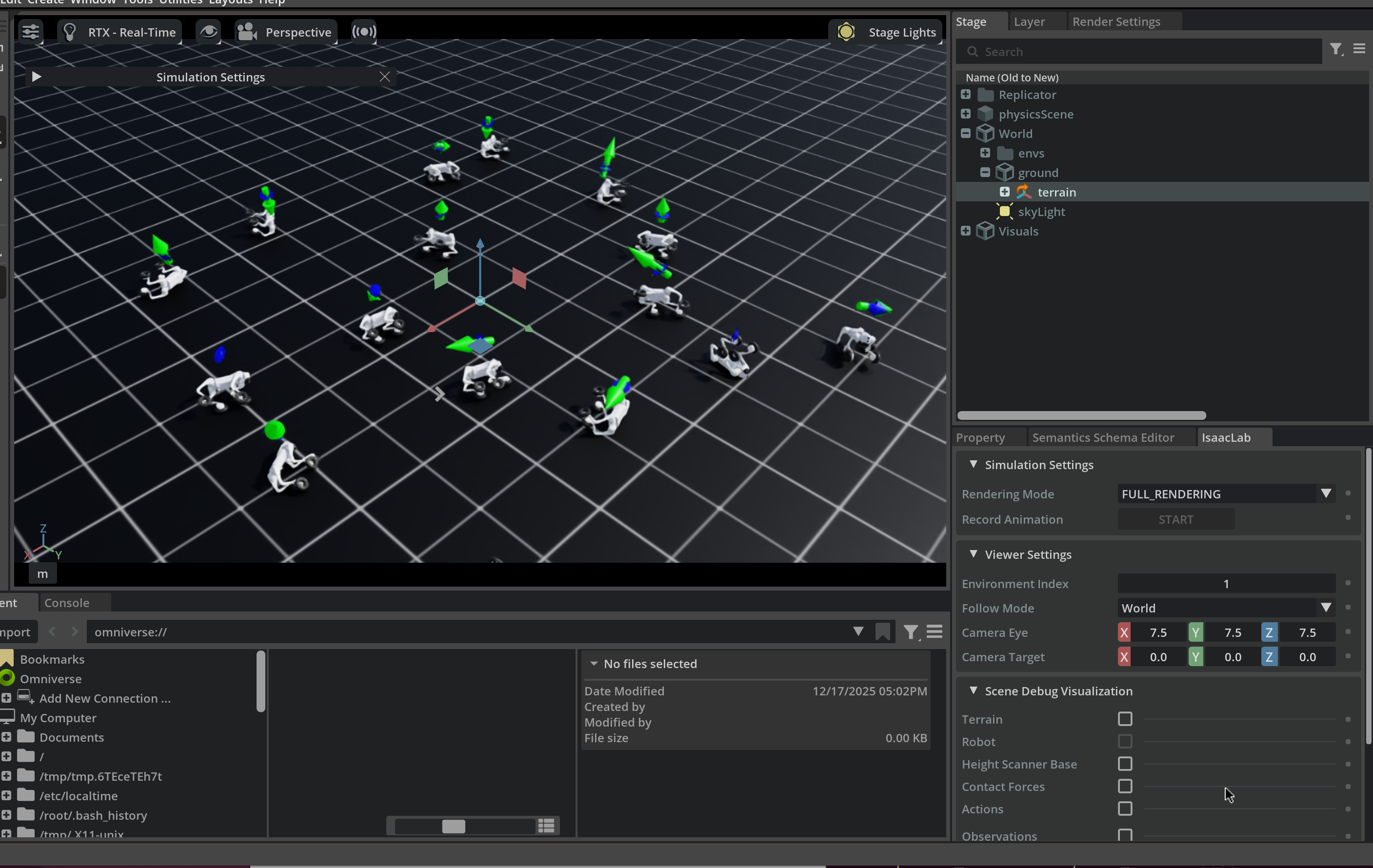
This launches Isaac Sim with 16 Go2-W robots training in parallel:
Full Training (Flat Terrain First)
./isaaclab.sh -p robot_lab/scripts/reinforcement_learning/rsl_rl/train.py \
    --task=RobotLab-Isaac-Velocity-Flat-Unitree-Go2W-v0 \
    --num_envs=4096 \
    --headless
Advanced Training (Rough Terrain)
./isaaclab.sh -p robot_lab/scripts/reinforcement_learning/rsl_rl/train.py \
    --task=RobotLab-Isaac-Velocity-Rough-Unitree-Go2W-v0 \
    --num_envs=4096 \
    --headless
Training Metrics
After ~100 iterations, you should see metrics like this:
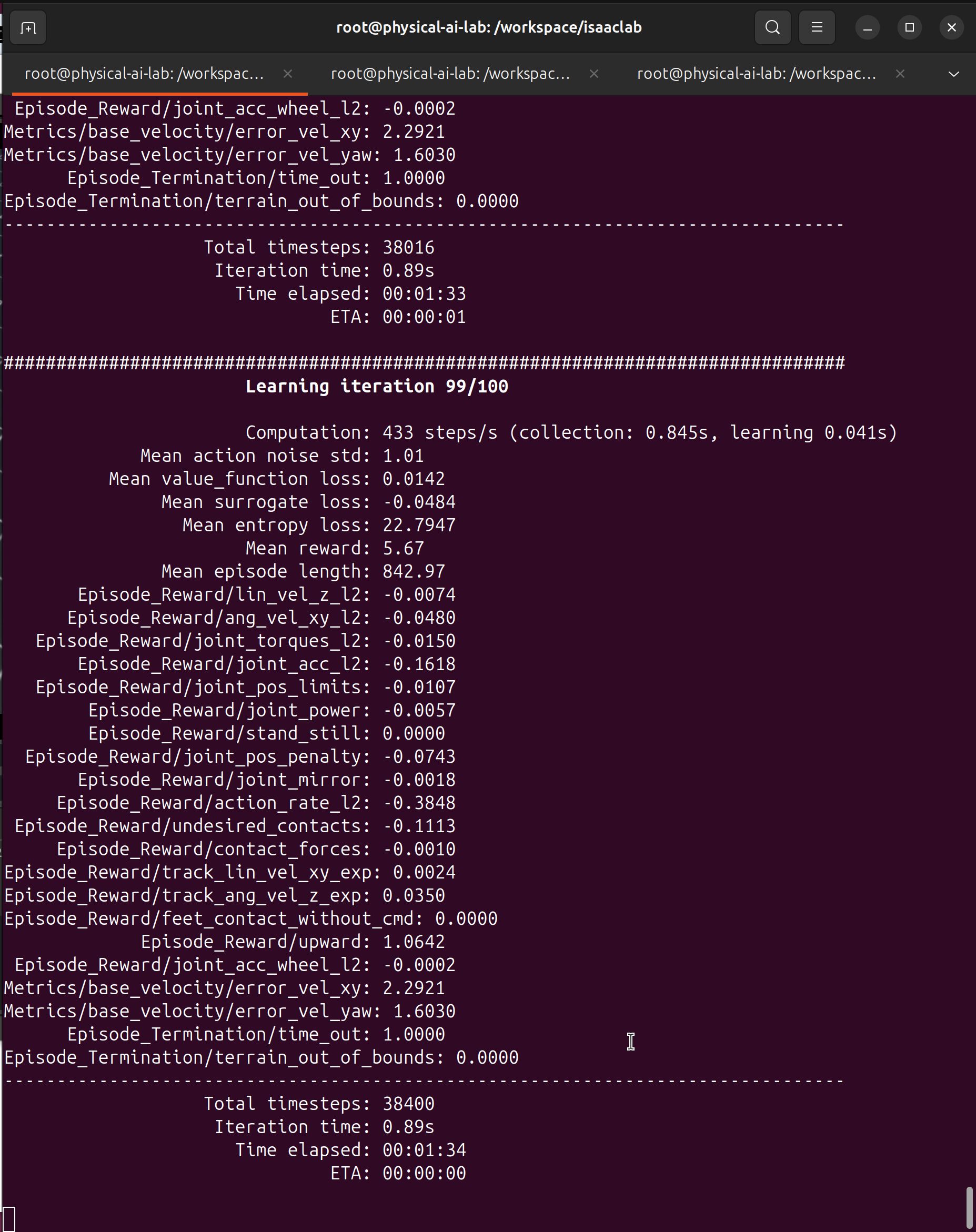
Key metrics to watch: - Mean reward: 5.67 - Positive and increasing = learning! - Mean episode length: 842 - Staying alive longer - Computation: 433 steps/s - Training speed
Evaluate Trained Policy
./isaaclab.sh -p robot_lab/scripts/reinforcement_learning/rsl_rl/play.py \
    --task=RobotLab-Isaac-Velocity-Rough-Unitree-Go2W-v0 \
    --num_envs=16 \
    --checkpoint=logs/rsl_rl/RobotLab-Isaac-Velocity-Rough-Unitree-Go2W-v0/TIMESTAMP/model_XXX.pt
Domain Randomization for Sim-to-Real
Go2-W requires wheel-specific domain randomization:
Standard Randomization
| Parameter | Range | Purpose |
|---|---|---|
| Ground friction | [0.4, 1.2] | Surface variation |
| Base mass | ±2 kg | Payload changes |
| Motor strength | [0.9, 1.1] | Motor wear |
Go2-W Specific Randomization
| Parameter | Range | Purpose |
|---|---|---|
| Tire friction | [0.5, 1.25] | Rubber degradation |
| Wheel imbalance | Random vibration | Manufacturing variance |
| Tire pressure | Affects contact patch | Pressure loss |
| Wheel motor delay | [0, 20] ms | Control latency |
Monitoring Training
TensorBoard
tensorboard --logdir=logs/rsl_rl/RobotLab-Isaac-Velocity-Rough-Unitree-Go2W-v0Key Metrics for Go2-W
| Metric | Good Sign | Bad Sign |
|---|---|---|
reward/mean |
Increasing steadily | Stuck or decreasing |
episode_length |
Getting longer | Staying short (falling) |
wheel_usage |
High on flat | Always high (can’t walk) |
slip_count |
Decreasing | Staying high |
Expected Learning Curve
Reward over Training:

    15 ─┐                                    ┌────── Converged
       │                                   /
    10 ─┤                                 /
       │                            ___/
     5 ─┤                    _____/
       │              _____/
     0 ─┼──────_____/───────────────────────────────────
       │    /
    -5 ─┘  /  Random
       └──┬────┬────┬────┬────┬────┬────┬────┬────┬────
          0   200  400  600  800 1000 1200 1400 1600 1800
                          Iterations

    Phase 1: Learn to stand (0-200)
    Phase 2: Learn to roll (200-600)
    Phase 3: Learn to walk (600-1000)
    Phase 4: Learn hybrid transitions (1000-1800)
Curriculum Learning Strategy
For best results, train Go2-W in stages:
Stage 1: Standing (velocity = 0)
# Learn to balance on wheels
--task=RobotLab-Isaac-Velocity-Flat-Unitree-Go2W-v0
# With zero velocity commands initially
Stage 2: Rolling Only
# Flat terrain, forward commands
--task=RobotLab-Isaac-Velocity-Flat-Unitree-Go2W-v0
Stage 3: Walking + Rolling
# Rough terrain forces leg usage
--task=RobotLab-Isaac-Velocity-Rough-Unitree-Go2W-v0
Training Logs Structure
logs/rsl_rl/RobotLab-Isaac-Velocity-Rough-Unitree-Go2W-v0/
└── YYYY-MM-DD_HH-MM-SS/
    ├── model_100.pt          # Checkpoints (16D actions)
    ├── model_500.pt
    ├── model_1000.pt
    ├── events.out.tfevents*  # TensorBoard logs
    └── config.yaml           # Training configuration
Troubleshooting
Problem: Robot Always Uses Wheels (Never Walks)
Cause: Energy penalty too high, or rough terrain not challenging enough
Fix: Reduce energy penalty weight or increase terrain difficulty
Problem: Robot Never Uses Wheels
Cause: Wheel actions not properly connected, or slip penalty too high
Fix: Verify wheel joints are velocity-controlled, reduce slip penalty
Problem: Oscillating Between Modes
Cause: Mode switching penalty too low
Fix: Increase mode switching penalty to encourage commitment
Problem: Policy Not Converging
Causes: - Observation space mismatch (expecting 45D, getting 53D) - Action space mismatch (expecting 12D, getting 16D)
Fix: Verify robot_lab configuration matches Go2-W specs
Quick Reference Card
┌─────────────────────────────────────────────────────────────┐
│           GO2-W TRAINING QUICK REFERENCE                     │
├─────────────────────────────────────────────────────────────┤
│                                                             │
│  INSTALL ROBOT_LAB (on HOST, with bind mount)              │
│  ─────────────────────────────────────────────             │
│  cd ~/docker/isaac-lab/IsaacLab                            │
│  git clone https://github.com/fan-ziqi/robot_lab.git       │
│  # Add bind mount to docker-compose.yaml                   │
│  # Restart container, then inside:                         │
│  pip install -e robot_lab/source/robot_lab                 │
│                                                             │
│  TRAINING COMMANDS (use robot_lab's scripts!)              │
│  ─────────────────────────────────────────────             │
│  ./isaaclab.sh -p robot_lab/scripts/.../train.py \         │
│    --task=RobotLab-Isaac-Velocity-Flat-Unitree-Go2W-v0 \   │
│    --num_envs=16 --max_iterations=100                      │
│                                                             │
│  KEY DIFFERENCES FROM GO2                                   │
│  ────────────────────────                                  │
│  Actions: 16D (not 12D)                                    │
│  Observations: ~53D (not 45D)                              │
│  Control: Legs=Position, Wheels=Velocity                   │
│  Reward: Energy penalty → hybrid behavior                  │
│                                                             │
│  MONITOR                                                    │
│  ───────                                                   │
│  tensorboard --logdir=logs/rsl_rl/RobotLab-...-Go2W-v0    │
│                                                             │
└─────────────────────────────────────────────────────────────┘
Workshop Questions
- Optimal energy penalty weight for hybrid behavior?
- How to encourage mode transitions without oscillation?
- Best num_envs for RTX 4090 with Go2-W?
- Curriculum learning vs end-to-end training?
- How does robot_lab handle the 16D action space internally?
What’s Next
With a trained Go2-W policy, we can deploy to real hardware:
→ Part 4: Go2-W Sim-to-Real - Export and deploy the hybrid locomotion policy
Sources
- robot_lab Extension - Go2-W environments
- RSL-RL - PPO implementation
- Isaac Lab Documentation
- Proximal Policy Optimization (PPO)